

The Human Cost of Workforce Decisions: Leading Restructuring Without Losing Yourself

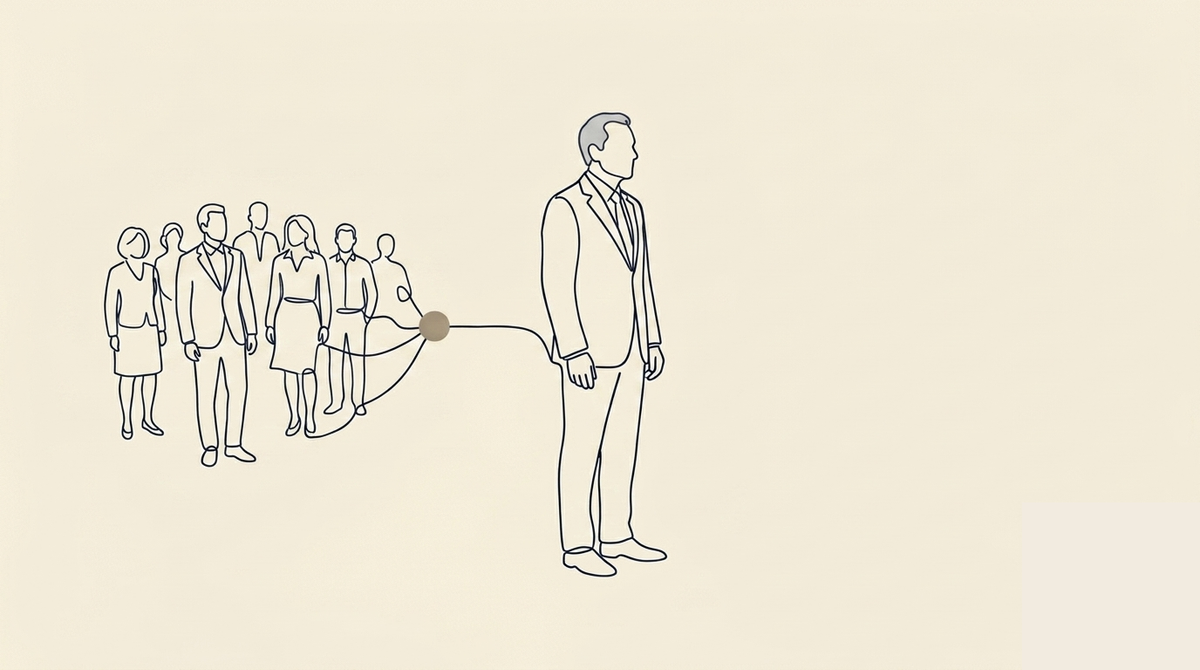
I've been the leader in that room. Sitting across from someone whose role I was there to end, holding the script HR had drafted and legal had signed off on, doing the one thing that made it bearable: stepping back from my own humanity so I wouldn't have to feel the weight of another person's loss. I called that distance professionalism, and told myself that holding it together was the job.
What stays with me now isn't the severance math or the approved language. It's that I wasn't really there. A person across the table was losing something that mattered, and I'd made myself just absent enough not to have to feel it with them.
It's rarely for lack of care about the process. By the time one of these decisions reaches the room, the machinery has been assembled with real attention. The decision made, the communication scripted, the severance calculated, the managers briefed on what to say. In forty-eight hours a significant number of people will learn that their roles no longer exist, and the organization has prepared for all of it, thoroughly, with one thing left out.
What hasn't been assembled with the same care is the interior of the leader who'll be in the room when it happens.
What These Decisions Actually Reveal
How an organization handles a workforce reduction is one of the most honest things it will ever show you about its actual values. Not its stated values, which tend to get written down in conditions of relative safety, when the cost of holding them is theoretical. What a reduction reveals is what the organization does when the cost is real and the pressure is on.
The people who aren't being let go watch this closely. They're learning, from the specifics of how it's handled, what the organization actually values: whether the humanity of the people it's releasing counts for something, or whether that humanity is an inconvenience to be managed efficiently. Whether the leaders delivering the news are genuinely present to what's happening, or executing a process from behind a professional distance.
They'll remember what they see. It shapes what they believe this organization is, what they can trust about it, and how much of themselves it's safe to give it.
The people who aren't being let go are watching how the ones who are get treated. They're learning what this organization actually values.
What the Process Cannot Do
Organizations put real effort into the machinery of a workforce reduction. The communication templates, the HR briefings, the legal reviews, the severance calculations, the transition support. None of this is cynical, and it all matters. A badly handled process causes real and unnecessary harm.
But the process can't do the work that only a present human being can do. It can't stand in for a leader who's actually in the room with the person receiving the news, not managing the conversation from behind a script, not executing a procedure, but genuinely with them in a moment that's genuinely hard.
I've watched how a lot of organizations choose to handle this, and the shape of it is almost always the same. A manager reads a short script, says as little as the lawyers allow, and hands the person off to an HR professional they've often never met to handle the rest. It's clean, it's defensible, and it's built from start to finish to keep any real human contact out of the room. The person losing their role never gets a genuine ending, the human completion a moment like this actually asks for. Neither does the leader. Both are spared the one exchange that would have let it land as something human, and both are quietly worse for it.
The person being let go won't remember the severance calculation as the main fact of the experience. They'll remember whether the person who delivered the news was actually present with them, or performing a professional function while managing their own discomfort at having to do it.
That distinction, between a leader who's genuinely present and one who's executing a process, is what human-centred leadership actually looks like here. And it asks the leader to do something no process can include: to reckon, honestly, with what this moment costs.
Key Insight
The person being let go won't remember the severance calculation. They'll remember whether the person delivering the news was actually present with them.
What a Leader Is Required to Feel
There's a version of leadership that treats the emotional weight of a hard decision as a professional hazard to be managed. The good leader, in this frame, is the one who can make the call without being shaken by it, execute the reduction, deliver the news, and get back to business without carrying the cost. We've been taught to call that strength.
This is a description of dissociation, not of strength. The leader who genuinely feels nothing during a workforce reduction is either not paying attention to what's actually happening, or has built a distance from the people they lead that will cost the organization later, in ways that are harder to measure and no less real.
Human-centred leadership asks for something more demanding: to feel the weight of the decision and make it anyway, to carry the cost to real people without letting it paralyze the call, to stay moved by what's happening and still functional enough to handle it with care. What it really asks is that the leader reclaim their own humanity before the performance, in the exact moment they've been trained to set it aside.
This is hard, harder than the professional distance, because it asks a leader to reach their own humanity in the exact conditions built to reward suppressing it.
Accountability in the Aftermath
Once the reduction has been made and the communications are done, the organization faces a second test: whether the leadership that made the decision is willing to be genuinely accountable for its human cost.
This means more than the all-hands message that acknowledges the difficulty and expresses confidence in the path forward. It means being available to the people who remain, to hear honestly what the experience was like for them. It means naming, specifically and without defensiveness, what the organization could have done differently. It means staying with the discomfort of the aftermath rather than pivoting quickly to the next chapter.
The organizations that handle these moments best aren't the ones with the smoothest communication plans. They're the ones where the leaders are genuinely accountable for the human cost of the decisions they made, where the accountability isn't a performance but a sustained attention to what the decision actually cost the people it touched.
The organizations that handle these moments best are the ones where leaders are genuinely accountable for the human cost, not the ones with the smoothest communication plans.
Micro-Practice
The Human Inventory
Bring to mind a hard organizational decision you helped make or carry out, one that cost people something. Then, as honestly as you can: what did you feel? What did you do with that feeling? What would genuine accountability for the human cost of that decision have looked like, not the professional kind, but the human kind? What would you do differently today, knowing what you now know about what it actually cost?