

What High-Performing Men Are Managing Underneath

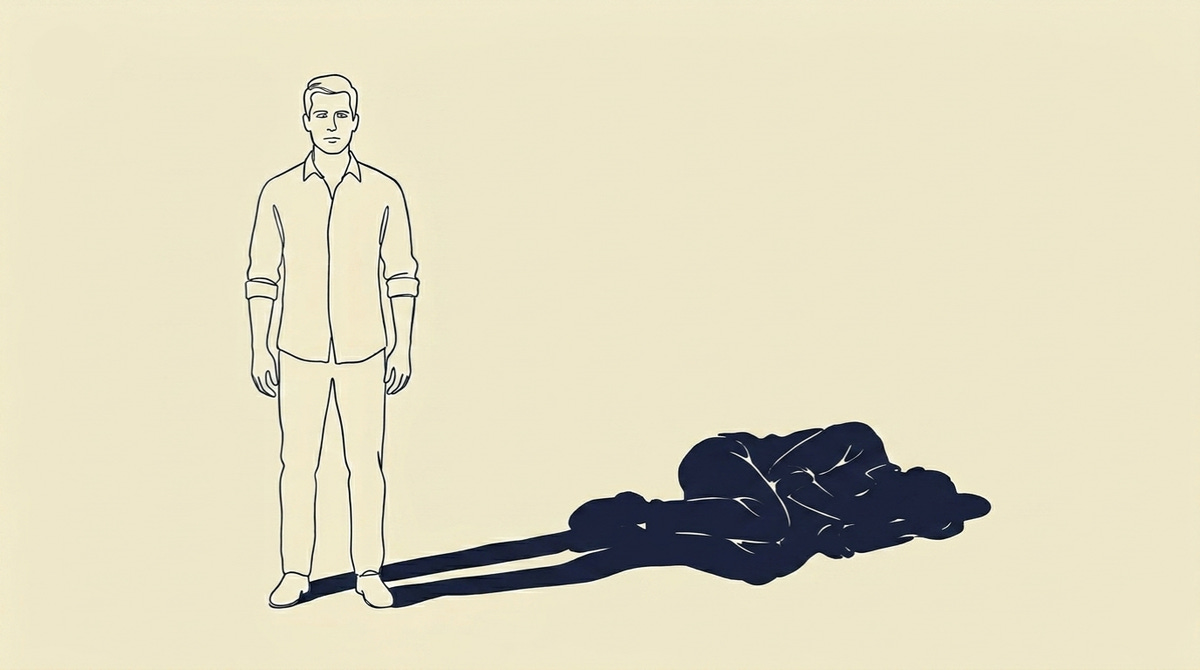
He has the career, the condo or the house in the city, the family or the serious relationship, the income that signals arrival. From the outside, he's exactly what he was supposed to become. From the inside, something has been going quiet for years, and he can't quite name it.
I know that quiet from the inside. I've spent years sitting across from men who live in it, and at a couple of points in my own life I've been that man too. What keeps surfacing, once the performance tires, isn't a broken man. It's a whole one who lost the thread back to himself somewhere down the line. And finding it again was never a one-time repair; it's a remembering you do, and lose, and do again, the way I still do. Whatever went quiet in him was never gone. It got covered over. The numbers are heavy, and what's underneath them is not.
This isn't a story about failure. It's a story about what success has cost a generation of men, and why that cost is finally showing up in the data.
Nearly one in two Canadian men report feeling socially isolated. For men who live alone, that number climbs to 73%.¹ Among men aged 18 to 34, 63% report experiencing considerable loneliness, a rate significantly higher than their female peers.² These are not statistics drawn from the margins. They describe a demographic that runs departments, builds companies, and anchors households across this country.
And it doesn't always stay quiet. Three in four suicides are male.³ For too many men, the isolation stops being a private ache and becomes the thing that ends a life.
And yet, if you sat across from most of these men at a dinner table or a board table, you probably wouldn't know it. That invisibility is the point. Somewhere between adolescence and the corner office, many men absorbed a set of unspoken instructions: produce, contain, manage, perform. Emotion is private. Weakness is liability. Strength is competence. To ask for help, not tactical guidance but genuine witnessing, is to break a code so deeply internalized it rarely surfaces as a conscious choice.
Instead, it often surfaces as distance. A shorter fuse at home. Relationships that have lost their depth. A career that functions but lacks meaning. A persistent sense of operating below capacity without being able to say where the gap actually is.
Men respond to this gap in different ways.
Some do it quietly and without drama, working longer, training harder, staying busier than the feeling requires. The calendar stays full and the discomfort stays managed. Nothing is technically wrong.
For others, the gap gets filled differently. A few extra drinks at the end of a hard week. Online poker or sports betting, small enough to seem harmless, regular enough to become a pattern. Hours lost to content that has more to do with disconnection than desire. Cannabis to take the edge off. A prescription that started for a reason and quietly became routine. Men have significantly higher rates of substance use disorders than women. Nearly one in five Canadians engages in heavy drinking. The data is clear: compulsive behaviour is a common way people cope with emotional weight they have nowhere else to put.
But the man who doesn't drink much, who runs marathons and shows up to every school event, who by every visible measure is doing everything right, he belongs in this conversation too. The gap he feels isn't smaller because his coping is “cleaner” by conventional standards. He's just better at outrunning it, or has found a better disguise. And at some point, even he starts to notice that the running isn't closing the distance. The armour holds. That's a big part of the problem.
Toronto, like many Westernized urban centres, rewards performance magnificently. The infrastructure of ambition is everywhere: the gym, the business accelerator, the networking dinner, the weekend warrior culture that converts even rest into achievement. Men here are not short on activity. They are short on witness. On being known, rather than recognized.
There's a distinction worth sitting with. Recognition is external: titles, outputs, impressions managed and landed well. Being known is different. It requires someone else to see past the performance, and it requires you to let them. For many high-performing men, that has almost never happened, not in the office, and often not since childhood.
The irony is that the men most isolated by this pattern are often the most socially fluent. They are good in a room. They read people. They know how to manage an impression. Those skills, useful in almost every professional domain, make the loneliness harder to detect. Even from inside it.
Two familiar answers reach for this gap, and neither reaches what's actually missing.
One answers the isolation by doubling down on the very thing underneath it: be harder, dominate the room, treat connection as leverage and call it strength. It's everywhere right now, loudest online, and it lands because it's speaking to something real. But it prescribes more of the armour as the cure, and the armour is the problem. It's the ache wearing the costume of identity.
The other asks men to take themselves apart, to apologize for how they were built, or to perform a new kind of openness that, done on cue, is just one more performance in a different key. The intention is good. It still leaves a man managing an image, only a gentler one.
Neither reaches the actual deficit.
What men are hungry for is something quieter and more difficult than either answer offers. Most wouldn't have a name for it. But they know exactly what its absence feels like: the sense of being in a room and not quite there. Of going through the motions of a life that looks right and feels thin. Of being recognized everywhere and known nowhere.
The capacity to close that gap is not softness. It's a skill, and for many men one that got quietly traded away somewhere between the first promotion and the second decade of marriage. It has a name in the research: presence. Not a concept. Not a practice to be optimized. A physical experience: the nervous system learning what safety feels like, through tone, attunement, and being genuinely met by another person.
And the discomfort that comes with being seen, the tightening a lot of men feel the moment someone gets close, isn't a sign that something's wrong. It's the nervous system reading closeness as danger, old wiring still doing the job it was given. Met instead of managed, that same discomfort turns into a guidepost, even a doorway, rather than a threat to outrun.
A lot of men never got enough of it, and many stopped expecting it. And so they built lives, high-functioning, well-defended, outwardly complete, around its absence.
The gap doesn't announce itself. It accumulates. And the leaders who finally close it don't do it by finding better strategies or working harder at their relationships. They do it by letting themselves be seen, in a context where that's actually possible. What becomes available on the other side of that is not a softer version of the man who walked in. It's a more grounded one: more present at the table, more honest in the room, more capable of the kind of leadership that actually lands.
That's the work. I've sat on both sides of it, the one being seen and the one doing the seeing, and I'm still learning to let myself be met too. It turns out to be some of the most important work a leader can do.
¹ Canadian Men’s Health Foundation, 2025. ² Movember Foundation, 2021. ³ Public Health Agency of Canada, 2025.
Micro-Practice
The Inventory of Managed Distance
Think of the three or four relationships in your life that matter most, at home, at work, wherever. For each one, Ask: Am I known here, or recognized? Not a judgement. Just a distinction. Known means they could tell you something true about you that you haven't performed for them. Recognized means they could describe what you've shown them. Then: Is that gap something I chose, or something that just happened? And finally: If I could let one person see one true thing about where I actually am right now, what would that be? This isn't about disclosure. It's about noticing what's actually there.
Key Insight
If you're carrying this yourself, you're not meant to carry it alone. In Canada, the 9-8-8 Suicide Crisis Helpline is there any time, by call or text at 988.